That precious commodity

There’s a whole lotta buzz about attention these days. Marketers compete for it. Brain games claim to improve it. I myself work hard just to harness it. Remember the days when a cup of coffee with a friend wasn’t interrupted by the beeps, burps and blinking lights of a cellphone? Those nifty little wonders breed a level of distraction that makes full attention a real challenge. And even if you’re all in on that cup of coffee, chances are your companion will be checking their own little bugger because that biochemically-propelled imperative is frankly hard to resist. And it’s not just the phones. Shiny new objects are everywhere, convincing us that be here now isn’t nearly as rewarding as the promise of that thing over there.

Unless of course you decide to resist. You tell yourself that you will no longer bow at the alter of distraction, that you and you alone will decide what’s worthy of your attention.

My experience is what I agree to attend to. Only those things which I notice shape my mind.  William James / The Principles of Psychology (1890)

Productivity, to say nothing of mood, energy and optimism, is exponentially plussed by a well-harnessed attention, particularly, according to research from the field of positive psychology, when attention is far more often directed to those things that bring pleasure, delight and purpose than to those things that detract and disappoint.

I sometimes think that the mind needs a bouncer–a worthy opponent that meets all new arrivals at the door and decides who gets to stay and who has to go. Meditation in all its varietals can in many ways serve as that bouncer for its potential to bring increased awareness to the mind’s various comings and goings including thoughts, feelings, distractions, attractions and yearnings. Eric Maisel notes that when attention is refracted in multiple and competing directions creativity will surely suffer. Ideally, the artist is equipped to bring a laser-beam focus to their projects and to remove all elements in their creative environment that would impede this.

Your attention is a precious commodity. No matter who or what may want it, you own it. And you’ll need it in full supply to do good work.


And the day came…

IMG_1621

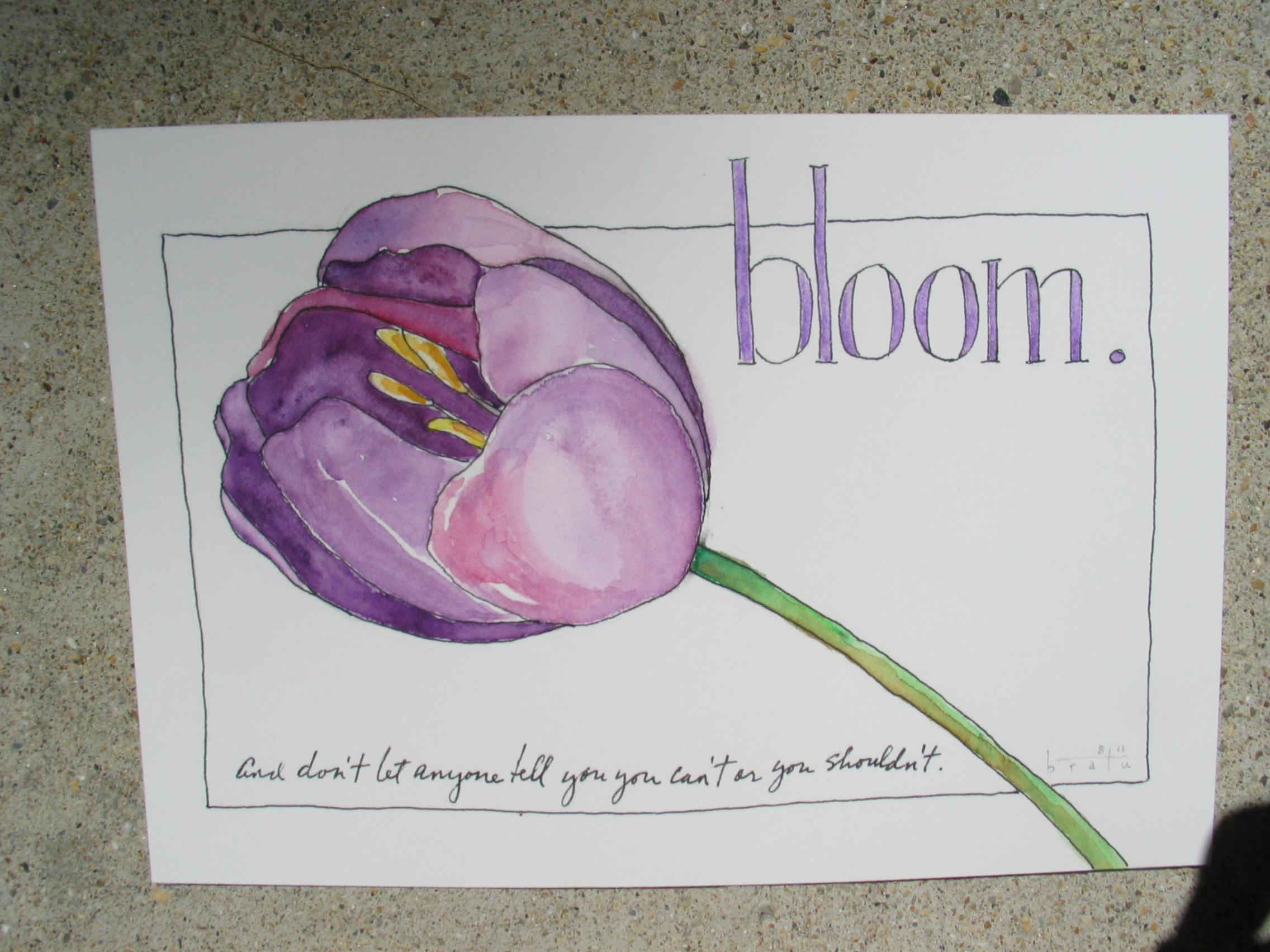
We, all of us, arrive on day one with some sort of music within us.  Circumstances either support that music in coming forward and being heard or conspire to make sure it remains silent.  I don’t refer here to “outside” circumstances–after all, history offers countless examples of folks who just flat out refused to keep their bloom in the bud, no matter how unfavorable, prohibitive or even life-threatening the outside circumstances might be–Gandhi, Chagall, O’Keefe, Graham, Frankl, Kahlo, Seeger, Steinem, Close…

Your desire to communicate must be bigger than your relationship with the chaotic and unfair realities.  ~Anna Deavere Smith in Letters To A Young Artist

The “inside” circumstances are the ones that fascinate me.  The notion that our internal conditions–meaning the ways we think, manage our emotions, take care of our bodies–can either water and feed or shackle and silence the maker inside all of us. And that these conditions are within our control to degrees far greater than the more traditional arms of psychology and neuroscience could ever imagine.  AND that approval for the establishment and maintenance of these conditions doesn’t go through a committee of 20 or even 12.  It goes through a committee of one.

These are the notions that leave me giddy.


Almost up and running

Sitting here with computer wiz Kevin Moriarity who’s offering counsel on my website, helping with those last lingering snags that despite my best efforts I couldn’t figure out on my own.

My stepson, Jason, is a genius geek who does websites in his sleep. The folks at ITS resolve all my office computer headaches, no problem. I’ve got friends, family, colleagues, many of whom know way more about this computer stuff than I do and would’ve been happy to help.

But I wanted to do my own website. It’s on a long list of things I told myself I could not do.

Turns out this was yet another fearful fiction.

Told myself I could never leave my full-time career in advertising and all it’s lucrative rewards to pursue a degree in psychology (earned my doctorate in 1994). Could never be my own boss (in my 13th year of self-employment). Could never figure out a Mac (typing on one now). Could never move art-making beyond my private practice and home studio work to an actual brick-and-mortar spot where groups of folks could do hands-on art-making (The Well Within Workshop is being constructed as we speak). There’s nothing special about me that isn’t also special about you. I could go on and on with my fears–the ones I’ve conquered and the ones that continue to have a hold on me. Bet you could, too. We’re built to be fearful, thanks to the amygdala, that neuro-structural CEO of fear. But we’re also built to stretch beyond those fears if we’re to reach our fuller potential. Neuroscience has proven this to be true.

I think of that NPR interview with David McCullough that ran awhile back, soon after the publication of 1776, in which the author went on at length describing in vivid detail the horrific conditions, the impossible barriers, the complete hubris that governed those men who crossed the pond with their sites set on independence, culminating with the statement: “You have to understand–there was nothing to suggest that this was going to work.”

That openness to operating beyond the fear and in the direction of possibility is a component of our collective ancestry. We’re all here because our ancestors made the heroic decision to leave where they were with their sites and their hopes set on something better. Don’t we owe it to them to keep moving further in that direction, facing our fears and moving toward something better? Art-making offers one place in which to do that. It continues to offer that to me and maybe you, too.

I’m too old to leave my amygdala in charge.  We have plenty of opportunity but we don’t have forever.