Rolling in the deep

0423030_0423030-R3-E070.jpg

I just got back from a 10-day intuitive painting training workshop with Deb Purdy of Creative Wings Studio and I’m still trying to wrap my head around it, though folks who’ve done this type of painting for any length of time will tell you that the head is one of the greatest impediments to true fulfillment. In other words, intuitive painting isn’t what you think.

The materials couldn’t be simpler—a large sheet of white paper and tempera paints, along with water containers for rinsing brushes. Prompted by clear instructions—Tape your paper to the wall, approach the paint and dip your brush into the color that seems to “call” you—the eight of us began.

“Keep the brush moving,” Deb suggests, and in time an image does indeed begin to appear, and then another, and another. Unlike traditional painting, where the artist begins with an idea for an image and then proceeds to paint, intuitive painting invites the participant to follow the lead of both the brush and the paint in order to, as Deb puts it, “bring forth the image that’s calling to be made.”

This raises a question: If the image doesn’t spring from the painter’s own head, from a process that involves thinking and planning, where does it come from? The unconscious? Maybe, but not in the way I’m used to thinking about the unconscious, that deep wellspring of material relegated for a host of good reasons to regions beyond one’s own conscious awareness. Intuitive painting seems to summon images that live 60,000 leagues under the unconscious.

Carl Jung was so convinced of the healing power of these images—archetypal images, as he termed them, embodying not the unconscious of one individual but the collective unconscious of all of human kind—that he broke away from his mentor, Sigmund Freud, in order to explore more deeply their fuller meanings and potentials. 

Seasoned intuitive painters suggest that we’re all perhaps a bit too enamored with “meaning” and that the painting process is a richer one when it’s free from shackling questions about what it all means. I myself tend to like meaning and can attest to the fact that those who find themselves without the capacity for meaning in life are individuals who suffer deeply. Meaning provides something undeniably vital for health and well-being. Survival itself is endangered, as Victor Frankl so influentially chronicled, without a sense of meaning. At the same time I can’t deny that I enjoyed a more profoundly gratifying experience over the course of the training when I managed to turn the meaning-making part of my thinking off. I felt energized and expanded, as if my own sense of myself, my life and my vision for what could be had now somehow enlarged, an awareness which has continued since my return home. I understand this to be yet another reminder that the mind is only so competent at comprehending the fullness of meaning, possibility and potential and that there’s value in moving the mind aside in order to access that deeper bounty.

Like the sea itself, the unconscious yields an endless and self-replenishing abundance of creatures, a wealth beyond our fathoming. ~ Carl Jung

Now more than ever I find myself needing experiences that offer deeper levels of restoration and replenishment. Whatever those may be for you, those portals and places that provide sorely-needed reprieve from the noise of life on land and an expanded sense of what could be, may you find yourself spending some quality time there, especially in the week ahead.

Photo credit courtesy of Dana G.F. Sterbens

Damn the electric fence.*

Years ago a friend told me about an event that happened one morning as he headed out his front door on his way to work. Getting into his car, he glanced across the street and noticed that the neighbor’s dog was sitting out on their front lawn. He’d been feeling a bit heavy-hearted for this pooch over the last several weeks, he told me, because his neighbor had installed an electric fence. Well-known in the subdivision for frequent wanderings that generated countless complaints, the dog now seemed subdued, maybe even depressed at his invisible confinement and my friend said he’d taken note of the changes in the dog’s disposition in the weeks since.

On this particular morning, though, he witnessed something altogether different. With fixed attention he watched as the dog suddenly stood up, almost as if responding to some sort of inaudible command. Then the dog began to walk in a circle, slowly at first but then with increasing momentum and velocity, spinning himself into a whirl, attempting, it seemed, to chase his tail at lightning speed. Is this what he’s doing, my friend asked himself? Is he chasing his tail?

And then it happened. My friend watched as the dog ran around and around, faster and faster and then, with an unexpected howl of emancipation and with sheer and unbridled delight he launched headlong, breaking thorough the electric fence. That pup bolted down the street, my friend described, running as if his life depended on it and never looking back.

There is no such thing beneath the heavens as conditions favorable to art. Art must crash through or perish.  ~ Sylvia Ashton-Warner

Many creative people come up against their own version of the electric fence—those elements in the artist’s life that create a forcefield which keeps the maker within familiar perimeters, commanding the creator to settle down, stay put. Sometimes the fence is invisible, but not always. This story has stayed with me over all these years, though, not because of the fence. I’m captivated by the image of the dog and the sheer force he brought to bear in readying himself to break through, to break free. I’m not sure we should expect it to be any easier or to require anything less as we move to respond to our own inaudible commands and I find it useful to remember that centrifugal force—that force that comes from one’s center—can often be an unstoppable propellant when it comes to breaking free and doing good work.
*Note:
Some readers will be reminded of Cow Poetry, The Far Side® cartoon by Gary Larson. Larson asks fans to avoid using his work on the internet and so I can’t include it here… damn.

Color me calmer

IMG_4198

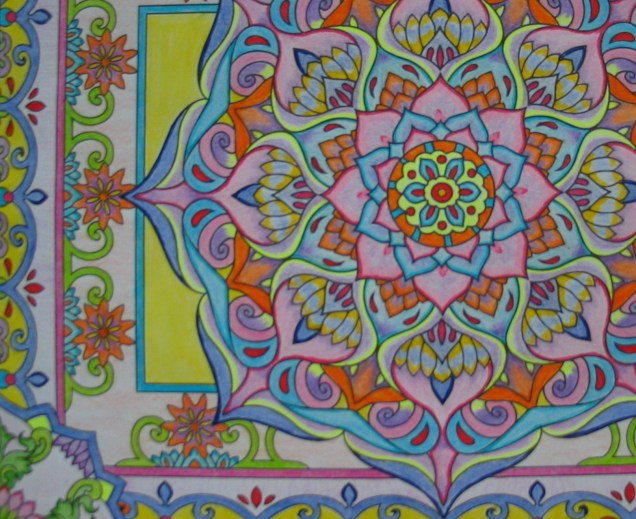
My bookkeeper, Evi, caught the coloring book fever not all that long ago and she tells me life hasn’t been the same since. She’s shown me the progression of her work from the beginning, lovely pages depicting mostly springtime palettes and, more recently, intricate gradations and shadings. To see Evi’s exuberance and the sheer force of her presence as she talks about coloring is to know that art-making brings something vital to her life.

But can coloring be considered art? If you ask Evi’s adrenal glands, they’d tell you they couldn’t care less. Researchers at Drexel University studied the effects of art-making on cortisol levels in the body. Elevated levels of cortisol, a stress hormone released by the adrenals and referred to by Psychology Today as “public health enemy number one,” have been implicated in anxiety, depression and a number of other physical and mental health conditions. The study found a statistically significant decrease in levels of the stress hormone following 45 minutes of art-making. Interestingly, the findings further revealed that cortisol levels dropped regardless of the subject’s prior art-making experience or levels of sophistication of the materials used, meaning that both seasoned artists and novices enjoyed a similar decrease in cortisol, whether they used sculptural clay or student-grade markers.

Participants in the study reported feeling relaxed after art-making, saying that the experience reminded them of creating as a child. Some reported feeling free from constraints. Others described an experience of “flow,” of losing themselves in the work. As Evi describes it:

Coloring takes my focus off the daily routines and stresses. It redirects my mind into creating something from nothing. It gives me the satisfaction that I’ve brought a piece of work to life.  It’s calming and soothing, and sometimes it’s a positive mental challenge in that some pieces make me dig a little deeper. Coloring is like an open window—it lets in fresh air for the mind.

Evi introduced her California friend, Wendy, to coloring. Wendy says:

Coloring gives me a way to completely clear my mind of everyday stresses and worries.  When I’m working on a picture, I get so involved that I don’t think of anything else and time flies.  Because I’m a stay-at-home caregiver to two aging pets with health issues, working on art affords me a peaceful way to keep myself occupied while still being attentive to their needs.  Best of all, I thoroughly enjoy the challenge of making the pictures come to life and hope to continue for years to come.

Color has forever had this effect on me, and maybe you, too. I swear that just looking at freshly-squeezed dollops of paint on my palette decreases my cortisol level. I could spit in a petri dish, stare at my colored pencils for 15 minutes and then spit again and I bet my cortisol would be lower. Or maybe it just feels that way…

While the debate continues as to what constitutes “art,” I see merit in asking different questions. Like, What constitutes health and how does my making support it?

(HT to Liz for news of the Drexel study)

Carrying the past

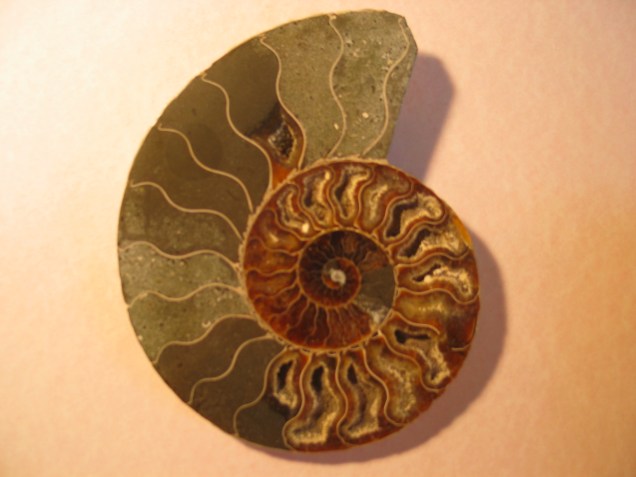
We were in Colorado recently visiting family and while there we checked out the Pikes Peak Gem and Mineral Show. Within minutes of entering the main hall, I’m stopped in my tracks by a magnificent site—a fossil of a chambered nautilus.

IMG_4175

The chambered nautilus is a “living fossil” that predates dinosaurs by about 265 million years. What’s captivated me ever since I learned about this ancient sea creature is its relationship to its past as reflected in its shell. The chambered nautilus begins its existence in a teeny space, or chamber. As it grows, it builds larger and larger chambers to inhabit, walling off the earlier space it has since outgrown in a design that allows only forward growth and movement. But these formerly-occupied chambers aren’t discarded. Instead they’re carried along and put to use, operating somewhat like an inflatable raft that allows the nautilus to remain buoyed as it navigates its present and heads toward its future.

Wouldn’t it be wonderful to carry the past in this way? To feel buoyed by it rather than weighted?

There was a time in my life when I went through a very difficult period of constant retrospective thinking about my shortcomings, my sins and misdeeds in the past. A friend of mine, a follower of existential philosophy, told me that I practiced what in the Middle Ages was called delectatio morosa, a term used to describe the way in which monks used to think about their past misdeeds and sins, meditating on them for days instead of doing what was necessary at the present. She said that our past is not static and that it constantly changes according to our deeds at the present. The things that we do at the present throw a light backward upon our previous shortcomings and deeds; every act of ours presently performed transforms the past. If we make use of them as a motoric force, for instance, that pushes us to do good things, we redeem our past and give a new meaning and a new sense to our past actions. ~ Czeslaw Milosz: Conversations (2006)

One final stroke of wisdom: While the nautilus roots itself in the outermost chamber of its shell, it spends most of its waking life protruding well beyond its perimeter. Living, as it were, outside the box.

P.S. If you find that your past is more of a weight than a buoy, check out Bouncing Back by Linda Graham. Combining mindfulness, relational psychology and neuroscience, I’ve found Linda’s book to be a resourceful work with many easy-to-implement strategies for building resilience.

The animating force

IMG_4083

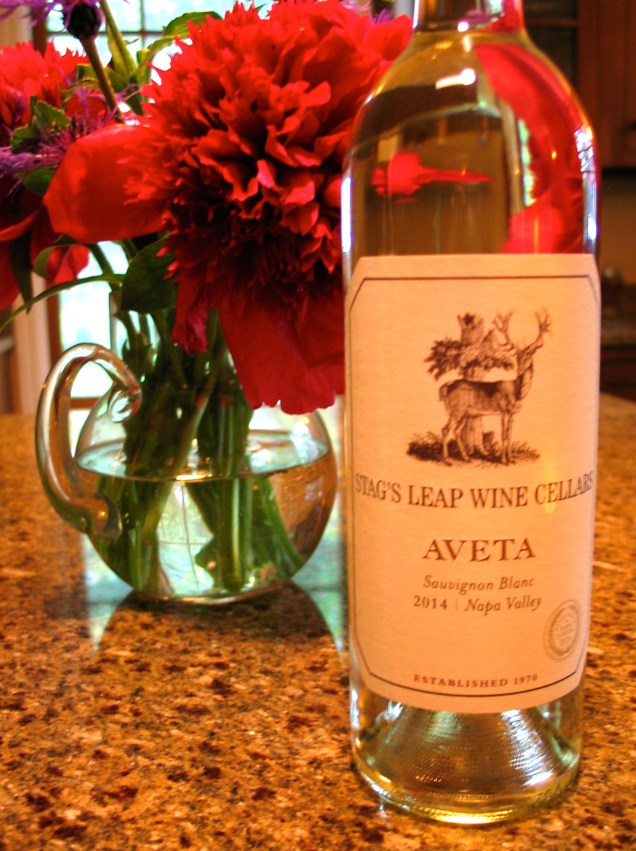
I met my friend, Mary, for dinner the other night and she gave me a bottle of wine to mark the 40th anniversary of the Judgment of Paris. The Judgment of Paris? I’m thinking World War II but the math isn’t quite right and so I ask.

I should note here that Mary’s “a wine person,” a connoisseur who sold fine wines to upscale restaurants in Chicago for years. Mary explains that she’s not so much into wine for the science or the stats. She’s into it for the stories, like the one about the Judgment of Paris.

In 1976, Mary tells me, a British fella living in Paris was hoping to drum up business for his flagging wine shop and came up with the idea of hosting a wine-tasting competition between the best wines of France and the mostly-unknown wines of California. He knew, of course, what the outcome would be, as did the townsfolk, so much so that aside from two young men who wandered in off the street and a reporter from Time magazine who grumbled about the assignment, the joint was empty. The competition went on in any event with nine revered French sommeliers and restauranteurs serving as judges. The results?  The California wines, both red and white, triumphed over the French.

To hear Mary tell it, I would’ve sworn she was there. And this is my point. Her eyes lit as she described the animating force that began with one man’s idea to have a contest, rocking the wine-making world not only in France but around the globe as vintners from Oregon to Australia now saw the possibility that they, too, could have a chair at the table. Captivated by the story when she’d first heard it, Mary says she picked up the book, a first-person account penned by that grumbling Time magazine reporter who’d gotten the scoop of his life, to learn more. In that book, she came across the names of the two young men who wandered in off the street to watch. One of the names was identical to the name of one of her Chicago restauranteurs. Could it be? She called the restaurant and asked him directly. Yes, he said, it’s me.

Which in turn prompted my friend to invite him to come and speak to her wine club, which he graciously accepted. She said the evening was sheer delight, history brought to life.

The animating force that prompted a British wine shop owner to have a contest. That prompted a couple of young passersby to stop in. That prompted a grumbling reporter to stay. That prompted vintners around the world to ask, “Why not?” That prompted the writing of the book. That prompted the invitation to speak.

That prompted my friend to tell me this story, and me to tell you. And speaking of you, what’s your animating force? And how do you honor it?


An achievement

I designed postcards to promote The Well Within Workshop and included a favorite Saul Bellow quote: Art has something to do with the achievement of stillness in the midst of chaos. It captures what I see as one of art-makings’s superpowers–offering the maker another place to be, another space to inhabit beyond the reaches of life’s confusion and turmoil. I emphasize this benefit in my work with clients and so wanted to incorporate it somehow on my postcards.

Viewing my now-printed cards back at home, I see that achievement as it appears has only two “e’s” whereas Bellow’s version has three. I don’t see this as a significant problem because I only ordered fifteen thousand copies…how did this happen?

However it happened, it’s what didn’t happen that caught my attention. Back in the day, this kind of thing would’ve sent me spinning–wretched self-criticism, harshness with the printer, fuel-injected agitation of my own making and all quite beyond my control.

Where did all that go?

I thank meditation for digesting so much of it. I don’t sit everyday but I’ve maintained an imperfect practice for over 15 years. And I thank middle-age, with all its invitations and opportunities to come to accept what is and be alright with it if for no other reason that the alternative is to be with what is and not be alright with it and that’s of course a little slice of hell on earth.

I’m at a point in life where I don’t want energy going in those directions anymore. It leaves me with nothing to show for it and seems to steal something vital from my art-making reserves.

Stillness in the midst of chaos.

I don’t kid myself. I could lose an “e” tomorrow and find myself percolating all over again. But I’m grateful today to have another option. I consider that an achievement.

p.s. If you’re at all interested in exploring the benefits of meditation in a non woo-woo way, check out Dan Harris’ book, 10 Percent Happier.


Refill the well.

I’m just now finishing Liz Gilbert’s Creativity Workshop, a bounty of a course offered on udemy. Once again she blows my mind. Her generous spirit, her gifted command of language that ignites and empowers, Gilbert continues to generate and share fresh approaches to nurturing and fiercely protecting the creative spirit. Unendingly warm and invitational, Gilbert offers uncomplicated strategies for watering and feeding the maker impulse at the ground level. Give up fetishist pursuits of passion, of changing the world with your work, Gilbert advises. “Get granular,” she says. “Start in your zip code.”

I especially appreciated Gilbert’s manifesto on what she calls “the end of martyrdom” which refers to the importance of swearing fidelity to health, optimism and forward movement in response to suffering and despair–your own or another’s:

I will love people freely and lightly and happily, or I will let them go.
I will allow people — especially other adults — to be responsible for their own lives. If other people are falling down hellholes, I will not tumble down those hellholes with them out of some mistaken sense of loyalty. (Compassion does not mean jumping into a pit of flame with anyone.) I will not stand in the fire anymore for anyone, or burn up my life for anyone, and mistakenly call that love.
I have a friend who said recently to me, “I liked you better when you were depressed. I was more comfortable with you then.”
My reply: “Well, I loved you then and I love you now. But I’m sorry — I won’t stay depressed just to keep you company, or make you feel better. I really do love you, but I don’t love you that much.” (Truth is, I don’t love ANYONE that much — because that ain’t love.)
I will not be loyal to suffering — neither yours or mine.
I will not be faithful to dysfunction — neither yours or mine.
I will not give you more than I (safely and sanely) have to give.
I will remember that we must take people as we find them, and that sometimes we must leave them there.
I will not stay in the darkness for ANYONE, and I won’t allow myself to be manipulated by anyone who feels they must drag me into their darkness for their own comfort…or that, if I refuse to stay in the darkness with them, I don’t love them.
No.
My life is an upward search — moving stubbornly toward the light — and you can come along with me, or I’ll see you later.
I will always take care of myself — because I recognize that if I don’t take care of myself, then I can never offer my useful service or my authentic love to anybody.
I will always work to fill my soul with grace and enthusiasm. Whatever energy overflows from me, I will happily and generously share it. But I will only share the overflow, because the rest of it, I need. I will not drain my wellspring to the dregs for anyone ever again, and mistakenly call that love.

Start to finish, this course comprises a rich offering that includes many, many insights from fellow artists and innovators with the contagion and the roadmap for living the most creative life possible. A fertile sequel to Big Magic. Check it out.

The Abandoned Art Project

IMG_4029My friend Anne mentioned an innovative artwork at a local coffee house and suggested I check it out. The artist calls the work “The Abandoned Art Project”–beautiful tags,  hand-crafted collage with an optimistic message. The idea is simple–buy a tag ($5 each) and then “abandon” it in an unlikely place, leaving the lucky recipient to feel serendipitously loved and cherished. Then the artist asks that the purchaser of the tag return to the coffee shop and leave a note indicating where the tag was abandoned.

I think this is lovely and buy four of them, finish my coffee and head over to Walmart. I turn into the parking lot and attempt to grab an empty space but see that the truck parked in front of me overshot the line. Now my tail-end is sticking out. Frustrated, I glance over at my passenger seat and see my four tags. I get out holding the tag that says “Dream” and place it under the truck’s windshield wiper. This attracts some unwanted attention–shoppers returning to the car next to mine look curious, wondering what this is all about. I capture my first abandoned art moment in a photo.

IMG_4032

I’m headed back to my car when the owner of the truck arrives. He doesn’t notice the tag but notices me noticing him. I smile and say that I left him a present. “A present?” he asks, then glances at his windshield and removes the tag, reads it and smiles. I briefly tell him about the local artist and the idea of abandoning these pieces in unlikely places as a way of spreading cheer. I didn’t mention his parking space overindulgence. He thanked me and said he hoped God blessed me. I said I hoped the same for him.

I’m grateful to the artist–I’d give credit but there was no name–for the vision and mission and the possibility it offered to me and a truck driver. If you’re near Geneva, IL, check out the work at Graham’s 318 on Third Street. I’ll be heading back there myself, to leave a note.


That precious commodity

There’s a whole lotta buzz about attention these days. Marketers compete for it. Brain games claim to improve it. I myself work hard just to harness it. Remember the days when a cup of coffee with a friend wasn’t interrupted by the beeps, burps and blinking lights of a cellphone? Those nifty little wonders breed a level of distraction that makes full attention a real challenge. And even if you’re all in on that cup of coffee, chances are your companion will be checking their own little bugger because that biochemically-propelled imperative is frankly hard to resist. And it’s not just the phones. Shiny new objects are everywhere, convincing us that be here now isn’t nearly as rewarding as the promise of that thing over there.

Unless of course you decide to resist. You tell yourself that you will no longer bow at the alter of distraction, that you and you alone will decide what’s worthy of your attention.

My experience is what I agree to attend to. Only those things which I notice shape my mind.  William James / The Principles of Psychology (1890)

Productivity, to say nothing of mood, energy and optimism, is exponentially plussed by a well-harnessed attention, particularly, according to research from the field of positive psychology, when attention is far more often directed to those things that bring pleasure, delight and purpose than to those things that detract and disappoint.

I sometimes think that the mind needs a bouncer–a worthy opponent that meets all new arrivals at the door and decides who gets to stay and who has to go. Meditation in all its varietals can in many ways serve as that bouncer for its potential to bring increased awareness to the mind’s various comings and goings including thoughts, feelings, distractions, attractions and yearnings. Eric Maisel notes that when attention is refracted in multiple and competing directions creativity will surely suffer. Ideally, the artist is equipped to bring a laser-beam focus to their projects and to remove all elements in their creative environment that would impede this.

Your attention is a precious commodity. No matter who or what may want it, you own it. And you’ll need it in full supply to do good work.


And the day came…

IMG_1621

We, all of us, arrive on day one with some sort of music within us.  Circumstances either support that music in coming forward and being heard or conspire to make sure it remains silent.  I don’t refer here to “outside” circumstances–after all, history offers countless examples of folks who just flat out refused to keep their bloom in the bud, no matter how unfavorable, prohibitive or even life-threatening the outside circumstances might be–Gandhi, Chagall, O’Keefe, Graham, Frankl, Kahlo, Seeger, Steinem, Close…

Your desire to communicate must be bigger than your relationship with the chaotic and unfair realities.  ~Anna Deavere Smith in Letters To A Young Artist

The “inside” circumstances are the ones that fascinate me.  The notion that our internal conditions–meaning the ways we think, manage our emotions, take care of our bodies–can either water and feed or shackle and silence the maker inside all of us. And that these conditions are within our control to degrees far greater than the more traditional arms of psychology and neuroscience could ever imagine.  AND that approval for the establishment and maintenance of these conditions doesn’t go through a committee of 20 or even 12.  It goes through a committee of one.

These are the notions that leave me giddy.